
国外能听网易云吗?海外党亲测有效的回国听歌/听书解决方案

国外能听网易云吗?If you’re an overseas student cramming for exams in a dorm in New York, or an expat sipping coffee in a Sydney café, you’ve probably faced this frustration: opening NetEase Cloud Music only to see grayed-out songs and the dreaded “This content is not available in your region” message. Your favorite Chinese singers like Jay Chou, Eason Chan, or the latest indie tracks are just out of reach. And if you’re into audiobooks, apps like Ximalaya or Lizhi FM might throw similar geo-block errors too. So what do you do when 在国外听不了国内的歌怎么办,or 在国外如何听国内的歌手?The answer lies in a reliable back-to-China accelerator—one that can bypass IP restrictions without sacrificing speed or security. In this article, I’ll share my personal experience with Tomato Accelerator, a tool that’s fixed all my overseas audio woes, plus break down how to choose the right accelerator and set it up for seamless listening.
Why Can’t You Listen to NetEase Cloud Overseas?
Before diving into solutions, let’s get to the root of the problem. Most domestic audio platforms like NetEase Cloud, QQ Music, and Ximalaya have strict copyright agreements that limit content access to users within China. These platforms use your IP address to determine your location—if it’s outside the country, you’re locked out of most copyrighted content. Even if you have a paid membership back home, it won’t help because the restriction is tied to where you are, not who you are. This is why you might be able to listen to some public-domain tracks but not the latest hits from your favorite artists.
What to Look for in a Back-to-China Accelerator for Audio?
Not all accelerators are created equal, especially when it comes to streaming audio. You don’t need a tool built for heavy gaming (though bonus points if it does that too), but you do need one that prioritizes stability, low latency, and compatibility with audio apps. Here’s what I looked for when choosing Tomato Accelerator:
Global Nodes & Smart Route Recommendations
An accelerator is only as good as its nodes. Tomato has a dense network of global nodes, including many in Asia-Pacific regions that are close to China. What I love most is its smart algorithm—when you open the app, it automatically scans all available nodes and picks the one with the lowest latency for your location. I tested this in Toronto: within 2 seconds, it connected me to a node in Singapore that gave me a 30ms ping to NetEase Cloud’s servers. No more manual node-hopping or guessing which one works best.
Multi-Platform Support & Multi-Device Access
As someone who switches between my phone, laptop, and tablet throughout the day, I needed an accelerator that works everywhere. Tomato supports Android, iOS, Windows, and Mac—so I can listen to NetEase Cloud on my iPhone during my commute, then switch to my Macbook when I’m working at my desk. Even better: one account lets me connect up to 3 devices at the same time. No need to buy separate subscriptions for each gadget.
Stable Unlimited Traffic & Specialized Audio Lines
Buffering mid-song is a mood killer. Tomato solves this with stable unlimited traffic—no data caps to worry about, even if you stream 8 hours of audiobooks a day. It also has specialized回国影音 and audio acceleration lines that are optimized for platforms like NetEase Cloud and Ximalaya. These lines use独享100M bandwidth per user, so you don’t have to share speed with other users. I’ve streamed high-quality FLAC tracks on NetEase Cloud without a single buffer, even during peak hours in Europe.
Data Security & Private Transmission
Privacy is non-negotiable for me. Tomato uses AES-256 encryption to secure all data transmitted between your device and its nodes. This means your listening habits, account details, and online activity stay private—no third party can track what you’re streaming. It’s like having a secure tunnel back to China that no one else can peek into. I never worry about my data leaking or being misused when using Tomato.
Real-Time After-Sales Support
Even the best tools have glitches sometimes. Last month, I ran into an issue where NetEase Cloud wouldn’t load after connecting to Tomato. I reached out to their support team via live chat at 2 AM (my time in London), and a technician responded within 5 minutes. They walked me through resetting the app’s network settings and switching to a different node—problem solved in 10 minutes. Their professional technical team is available 24/7, which is a huge relief for overseas users in different time zones.
Step-by-Step Guide to Using Tomato Accelerator for NetEase Cloud
Setting up Tomato is straightforward—even if you’re not tech-savvy. Here’s how I did it:
First, go to Tomato’s official website and download the app for your device. I use an iPhone, so I grabbed it from the App Store (note: you might need to switch your App Store region to China if you can’t find it—alternatively, download the APK from their website for Android). For Windows or Mac, the desktop version is easy to install too.
Next, sign up for an account. They offer a free 3-day trial, which is perfect for testing if it works for you. Once you log in, the app will automatically scan your location and recommend the best node. I just tapped “Connect” and waited 2 seconds for the green light to pop up.
Then, open NetEase Cloud Music. You’ll notice that all the grayed-out songs are now playable. I searched for Jay Chou’s “Fantasy” album—every track loaded instantly. I also tried streaming an audiobook on Ximalaya (“The Story of the Stone”) and it worked just as well. If you ever want to switch apps, Tomato stays connected in the background, so you don’t have to reconfigure anything for QQ Music or Lizhi FM.
One pro tip: if you’re using a desktop, you can manually select the “回国影音专线” from the node list. This line is specifically optimized for streaming, so it’s even more stable for long listening sessions.
Beyond NetEase Cloud: Access Other Domestic Audio Apps
Tomato isn’t just for NetEase Cloud. I’ve used it to access almost all domestic audio platforms: QQ Music (for its huge library of K-pop and Mandopop), Ximalaya (for audiobooks and podcasts), Lizhi FM (for live radio shows), and even small indie apps like Migu Music. Whether you’re into listening to traditional Chinese stories on Ximalaya or catching up on the latest pop hits on QQ Music, Tomato has you covered. I once used it to stream a live concert on NetEase Cloud’s “Cloud Live” feature—no lag, no buffering, just crystal-clear audio.
Common Issues & Fixes for Overseas Audio Streaming
Even with a great accelerator, you might run into small issues. Here are some fixes I’ve learned:
If you experience buffering, try switching to a different node. Tomato has hundreds of nodes, so there’s always an alternative. I once had trouble in Paris—switching from a node in Tokyo to one in Hong Kong fixed the problem instantly.
If an app like Ximalaya still doesn’t work, restart both the accelerator and the app. Sometimes, apps cache your old IP address, so a quick restart clears that up.
If you’re on a public Wi-Fi network (like a university dorm or café), you might need to enable “Smart Split Tunneling” in Tomato. This feature lets you route only domestic app traffic through the accelerator, while keeping other traffic (like Google or Facebook) on your regular network. It saves bandwidth and makes the connection even more stable.
Final Thoughts: Get Back to Your Favorite Audio Content
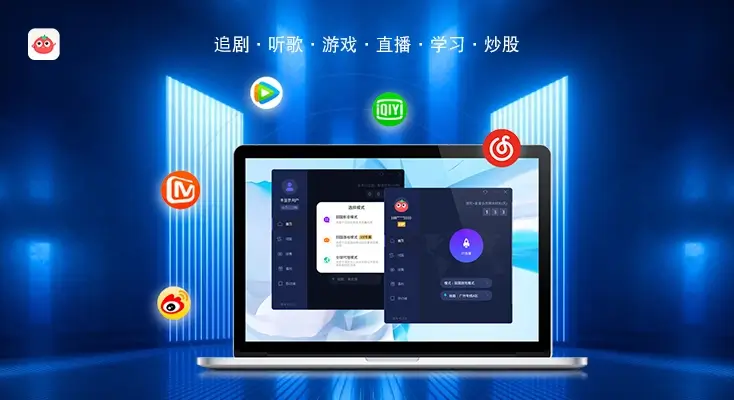
Going back to the original question: 国外能听网易云吗?Absolutely—if you have the right tool. Tomato Accelerator has become an essential part of my daily life as an overseas student. It lets me listen to Jay Chou while studying, stream Ximalaya audiobooks on my commute, and even catch up on the latest Chinese pop trends. No more geo-blocks, no more buffering, no more frustration. If you’re tired of missing out on your favorite domestic audio content, give Tomato a try—its free trial lets you test all its features without any risk. After all, music and stories should be accessible no matter where you are in the world.